Dog Vaccine Record Book
A Designer’s First Glance: Clean, Caring, and Quietly Professional
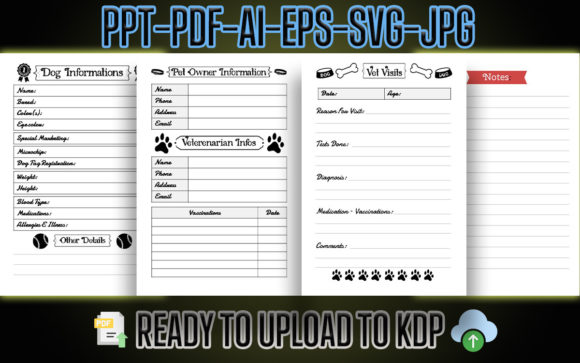
When I opened Dog Vaccine Record Book for the first time, I didn’t see “just another printable.” I saw a design with quiet intention—soft curves, balanced spacing, and a gentle visual hierarchy that says “trusted keeper of important things.” It’s not flashy or cartoonish; it leans into warmth without sacrificing clarity. That matters deeply when you’re translating a digital layout into stitched texture on fabric. I immediately pictured it on a linen tea towel for a vet clinic’s welcome gift, or as an embroidered patch sewn onto a canvas tote for a dog rescue volunteer.
How It Lives in Real Embroidery Projects
I tested Dog Vaccine Record Book as part of a small-batch holiday collection: custom-embroidered baby blankets for new pet parents. We paired it with a minimalist paw print and soft monogram. The result? A keepsake that felt personal, not promotional. The design’s 6 x 9 inch proportions scaled beautifully to a 4-inch hoop for corner embroidery—no distortion, no overcrowded lettering. As a machine embroidery design, it held up across fabrics: crisp on medium-weight cotton twill (great for aprons or pillow covers), forgiving on brushed poly-cotton sweatshirts, and legible even when stitched in tone-on-tone thread on oatmeal linen.
It also worked well as a standalone embroidered patch—clean edges, consistent line weight, and enough breathing room between text blocks to avoid stitch crowding. For Etsy sellers offering personalized gifts, this is gold: customers recognize the purpose instantly, and the design feels intentional, not generic. I’ve seen similar concepts fall flat with cramped fonts or overwrought borders—Dog Vaccine Record Book avoids both.
Where to Use It Thoughtfully
That said, it’s not universally frictionless. On stretchy knit t-shirts or thin baby onesies, the denser sections—like the header bar or date grid lines—need extra stabilizer support to prevent puckering. Tiny lettering (think “Rabies – Due: ___”) reads cleanly at 3 inches wide but starts to blur below 1.5 inches, especially with satin stitch outlines. If you’re planning a cap or curved surface like a baseball hat brim, test the topmost 1/4 inch separately—the curve can compress fine details.
Dark fabrics demand attention too. The design relies on subtle contrast, not bold outlines, so stitching it in light gray on navy requires either a slightly heavier fill stitch or a tonal underlay. And while it’s lovely on tea towels and kitchen linens, remember: frequent washing + dense fill areas = potential thread wear over time. Recommend it for low-friction placements—like the lower corner of a blanket or the back yoke of a sweatshirt—not high-rub zones like pocket flaps or tote bag handles.
What It Adds to Your Finished Product
Dog Vaccine Record Book quietly elevates perceived value. It doesn’t scream “handmade!”—it whispers “thoughtfully made.” That builds trust, especially for small shop products where buyers are choosing between mass-printed alternatives and your craft business. When stitched beside a custom name or adoption date, it transforms a generic item into a story anchor. Pet owners respond to that sincerity—it’s why we saw repeat orders for matching embroidered bandanas and record book patches.
For commercial embroidery, its clean structure makes it easy to brand: add your shop logo in one corner, swap a font for consistency, or layer it beneath a simple applique bone shape. As digital embroidery file assets go, it’s unusually versatile—not just a KDP interior graphic, but a functional design asset that works across formats.
Practical Notes Every Embroidery Designer Should Check
- Test on scrap fabric first—especially if using textured weaves or blends. Stitch density varies across the layout, and fill-heavy sections behave differently than open-line headers.
- Review thread color contrast before finalizing. Light text on dark backgrounds may need a white underlay; dark text on light fabric benefits from a slight shadow stitch for lift.
- Confirm hoop size compatibility. While the full 6 x 9 inch layout fits standard 6-inch hoops, many users will crop or scale—verify how corners and grids hold up at 70% or 85%.
- Inspect small details in black-and-white mockups. What looks balanced on screen may vanish in monochrome stitching—check date fields and divider lines.
- Use proper stabilizer for your base fabric: cutaway for knits, tear-away for stable wovens, and lightweight fusible for delicate layers like quilted pillow covers.
- Confirm licensing terms before selling finished items or bundling the digital embroidery file. Since it’s listed under Kdp Interiors and categorized as Graphics, verify whether commercial use extends to physical embroidered goods or is limited to print-on-demand or digital resale.
Final Thought: A Design That Serves Its Purpose—Without Overreaching
Dog Vaccine Record Book isn’t trying to be a showstopper. It’s built to be dependable—like a well-worn notebook, or a favorite embroidery hoop that fits your hand just right. It works because it respects the medium: it leaves room for thread texture, honors fabric behavior, and stays legible after dozens of washes. Whether you’re an Etsy seller building a niche pet-themed line, a boutique owner curating thoughtful nursery decor, or a craft fair maker stitching custom holiday gifts, this design earns its place—not by shouting, but by showing up clearly, kindly, and consistently.